

Japan… a country where ancient tradition meets neon futures, and one of the most visited destinations on Earth.
Before you dive into the temples, ramen shops and electric streets, it helps to understand the heart of Japanese culture – starting with how to greet people.
In Japanese culture, the art of bowing, known as “ojigi,” holds significant importance and is ingrained in social and business etiquette in its citizens from a young age.
Bowing is one of the most important aspects of their interpersonal relationships.
In a culture based on respect for others, the so-called “bow” or ojigi (おじぎ) takes on great significance in Japanese society.
For foreigners traveling, studying, or working in the country, it may not be very easy at first to understand the intricacies of this ancient art and tradition.
If you’re one of those people, know that we’re here to help you. In this blog, you’ll understand why Japanese people bow, how they bow, and the different ways of showing respect to others.
Why do Japanese people bow?
Even if Western-style handshakes show up in modern business and big cities, Ojigi is still the standard way to greet in Japan. The main function of this form of Japanese reverence is to show respect for others. Every time a Japanese person bows to you, they do so with a purpose, such as showing respect, thanking for something, asking for a favor, or simply apologizing.
Often it’s done unconsciously because, for Japanese people, ojigi is a tradition ingrained in their culture, so they do it almost automatically.
Just like any other type of honorifics, bowing also reveals the degree of hierarchy present in a particular social relationship. The way a person bows before another reveals their hierarchical position, being an efficient form of non-verbal communication.
How to bow?
To avoid faux pas, it’s important to be attentive to the rules, and Japanese culture is full of them. Understanding and executing them perfectly will show Japanese people how much you care and respect them.
To simplify things, here are the main steps of how to bow:
- Bring your feet together and maintain a straight posture.
- Bow your upper body from the waist up and keep the lower part perpendicular to the ground.
- Keep your face straight, meaning look towards the ground during the Japanese bow. Never look directly at the other person’s face; in Japanese etiquette, this is considered rude.
- After completing the bow, gradually return your body to its original position.
There are also differences between men and women:
- Men should always keep their arms at their sides.
- Women should clasp their hands and move their arms in front of the body at waist height.
Types of Japanese bows
The types of Japanese bows differ by the angle of inclination. The more informal the situation, the less you need to bow. Likewise, when dealing with people considered to be of higher social status or senior roles, you need to bow with more inclination as a sign of respect.
There are many theories about ojigi that vary according to the manual, with angles of 5°, 10°, 15°, 30°, 45°, etc. To simplify the explanation, we’ll limit it to the three main types: eshaku (会釈, えしゃく), keirei (敬礼, けいれい), and saikeirei (最敬礼, さいけいれい).
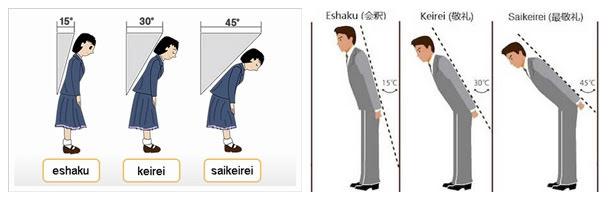
- Eshaku: bow with a 15° inclination. Common among people of the same hierarchy and can be used as a casual way of greeting or a polite way of thanking.
- Keirei: bow with a 30° inclination. Very present in formal situations such as in the business world, used to greet business partners or clients. It’s also used by students or employees of companies to address teachers or bosses.
- Saikeirei: bow with a 45° inclination. The most formal way of bowing and also the least used. Reserved for meetings with people in the highest echelons of society such as heads of state, princes, or emperors. It can also demonstrate serious regret or a profound apology.
Even after reading this entire guide, it may be difficult to deduce which type of bow is most appropriate for each situation. To achieve perfection and act like an authentic Japanese person requires a lot of practice, but know that the simple act of trying to perform ojigi will be well received by the natives and can lead to important contacts and friendships in Japan.
It may also be that after several mistakes and much accumulated experience, you find yourself bowing to other people without even thinking, as if it were a habit, just like the natives do.
If this happens, you’ll be bowing in interactions with animals, to greet the opposing team before a sports match, before passing under the gate of a Shinto shrine, or even when talking on the phone!
There are many possible situations, and even Japanese people discuss this subject a lot amongst themselves.
Bowing Contests
In Japan, where politeness and respect hold significant value, bowing can occasionally turn into a friendly competition.
This phenomenon is particularly notable among individuals of similar social status. Each person may feel a sense of obligation to reciprocate every bow they receive.
As the exchange progresses, the bows may gradually diminish in size until they become almost imperceptible gestures. Typically, this signals the conclusion of the “contest,” and both participants move forward with their interaction.
Balancing Cross-Cultural Encounters
Cross-cultural encounters in some cases involve a mix of handshakes and bows as a sign of respect for each other’s customs. Handshakes are rare in Japan but carry significant meaning, symbolizing strong relationships and important agreements.
While bows are the traditional greeting, in certain situations, such as business meetings, handshakes may be offered instead.
When uncertain about which gesture to use, it’s best to observe and follow the lead of others to ensure smooth interactions
Having gone through this article, you should now possess a solid understanding of the proper way to Greet in Japan.
Just a friendly reminder: when bowing in close quarters, it’s advisable to lean slightly to the side to avoid any unintentional collisions.
Get insider tips, ask questions and connect with fellow travellers in our members-only groups
Because travel’s better when we share it.



Responses